Á½ÐÔÉ«ÎçÒ¹

Five Challenges, Countless Possibilities

Looking Back at the 2025–2026 Elliot DI Student Fellows Program

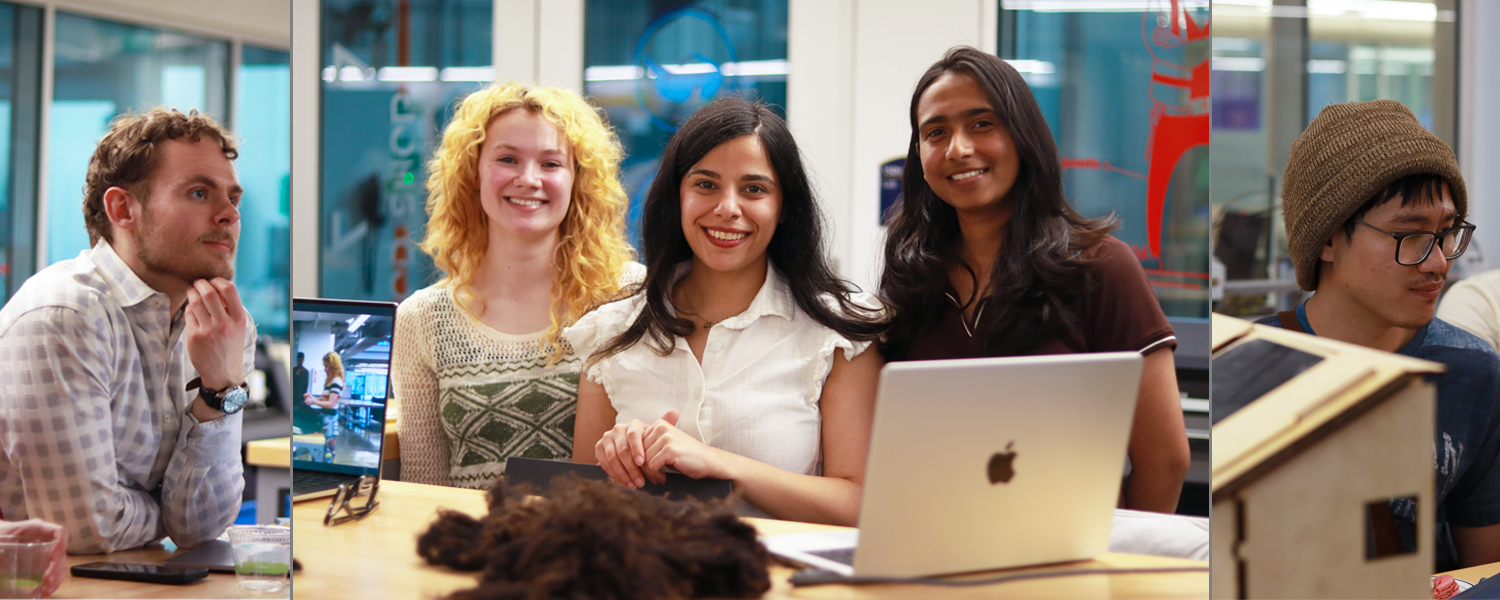
For nineteen Á½ÐÔÉ«ÎçÒ¹ students, the 2025–2026 academic year was more than a series of classes, assignments, and exams. It was an opportunity to tackle real-world challenges, collaborate across disciplines, and turn ideas into action through the John and Fonda Elliot Design Innovation Student Fellows Program.

Throughout the year, nineteen DI Fellows representing disciplines ranging from architecture and engineering to fashion design, visual communication design, business, biology, and computer science worked in interdisciplinary teams to address complex community, environmental, and societal challenges. Guided by Design Innovation tools, methods, and mentorship, DI Fellows developed solutions to real problems while building leadership, teamwork, communication, and creative problem-solving skills that will serve them long after graduation.

"The Elliot DI Fellows Program is really about giving students the opportunity to learn by doing," said Chris Holthe, Director of the Design Innovation Hub and facilitator of the Elliot DI Student Fellows Program:

"Each year, our DI Fellows take on challenges that don't have clear answers, work with teammates from completely different backgrounds, and learn how to navigate uncertainty together. Watching these teams grow, develop ideas, and create solutions that can make a real impact is one of the most rewarding parts of the program."

The program is made possible through the generosity and vision of John and Fonda Elliot, whose endowment continues to provide Á½ÐÔÉ«ÎçÒ¹ students with opportunities to develop as leaders, explore new ideas, and make a positive impact on their communities through challenge-based learning and innovation.


 

From Challenge to Solution

The Elliot DI Student Fellows Program begins each summer with a competitive application process. Students from any major, campus, or academic level are invited to apply, with a cohort of up to twenty DI Fellows selected each year.

DI Fellows working together to build a tower of shoes

The experience officially begins at the annual DI Fellows Launch Event. During this event, students meet one another, learn about their peers' backgrounds and strengths, and hear challenge pitches from faculty, staff, nonprofit organizations, community leaders, and external partners. Importantly, sponsors are not asked to present solutions. Instead, they are asked to present problems worth solving.

A strong challenge pitch focuses on the problem itself, why it matters, who it impacts, and what success might look like—while leaving room for students to discover unexpected possibilities. Sponsors are encouraged to think broadly and remain open to solutions that may take the form of products, campaigns, educational experiences, digital tools, services, or entirely new approaches.

Following the challenge pitches, DI Fellows select the projects that interest them most and form interdisciplinary teams. Over the course of the academic year, these teams work through the Design Innovation Toolkit and a structured process of team building, empathy, research, insight gathering, brainstorming, making, testing, and iteration. Along the way, teams receive support from challenge sponsors, Design Innovation staff facilitators, faculty mentors, and community partners.

The journey culminates each spring at DI Day, where DI Fellows showcase their work and share what they have learned with the broader university community.

"The goal isn't just to produce a solution," said Holthe. "The goal is to help students develop the confidence, creativity, and collaboration skills needed to tackle complex challenges in their real lives. The projects are important, but the learning that happens throughout the process is what makes the experience transformational."


Five Teams. Five Challenges. Endless Possibilities.

This year's DI Fellows worked on five community-based innovation challenges that explored issues ranging from worker safety and homelessness to sustainability, environmental awareness, and circular textile economies:

Heat Shield: Protecting Workers from Extreme Heat

Working with the Community Engaged Research Institute, Frank DePascale (Architecture), Nabin Bhatta (Aeronautical Systems Engineering), Roshan Renney (Mechatronics Engineering Technology), and Theorose Dzineku (Communication and Information) explored how wearable technology could help protect outdoor workers from the growing dangers of heat exposure. The interdisciplinary team developed a concept for a low-cost wearable device that monitors environmental conditions and provides immediate visual alerts when dangerous heat levels are detected. The team focused on accessibility, ease of use, and affordability, creating a solution that could support farmers, construction workers, and others who work in extreme temperatures. Their final concept included a washable armband with a detachable sensor module and a simple color-coded alert system designed to communicate risk without requiring smartphones or complicated technology.

Homelessness: Preventing Crisis Before It Happens

Working alongside Larry Armstrong of Orange County United Way, Jacob Nicholson (Visual Communication Design), Julian Leff (Business Analytics and Computer Information Systems), and Kolapo Fasina (Cell and Molecular Biology) tackled one of society's most persistent challenges by focusing on prevention rather than response. Through research, interviews, and prototype development, the team investigated how funding and support resources could reach individuals before they enter the cycle of homelessness. Their work led to the exploration of a digital platform designed to connect people in crisis with available assistance more efficiently while providing charitable organizations with better information to guide decision-making.

Invisible Fibers: Revealing Hidden Sustainability Opportunities

Partnering with Rust Belt Fibershed, Amy Zink (Fashion Design), Mounika Seelam (Computer Science), and Nilou Bahramian (Visual Communication Design) explored a challenge hidden within the textile industry. The group investigated how thousands of pounds of locally produced fiber—including waste wool from livestock operations—often go unused because producers and makers lack effective ways to connect. Their work focused on developing a data-driven mapping and educational framework that could help farmers, artisans, and manufacturers identify opportunities for collaboration while supporting a more sustainable regional textile ecosystem. The project also included the development of workshops and community engagement activities designed to make invisible fiber systems more visible and understandable to the public.

Litter on Campus: Changing Behavior Through Design

Working with Á½ÐÔÉ«ÎçÒ¹ University Grounds Services, Annie Riley (Visual Communication Design), Isha Gupta (Computer Science), Meadow Weiss (Visual Communication Design and Psychology), and Olivia Diemert (Visual Communication Design and Photography) approached campus sustainability through the lens of human behavior and visual communication. Rather than focusing solely on waste management infrastructure, the team investigated why people litter and how design interventions might encourage more responsible behavior. Their resulting concept centered on transforming campus trash cans into engaging educational tools through visually compelling wraps, messaging campaigns, and interactive design elements intended to make students more aware of their environmental impact and the hidden labor involved in maintaining campus spaces.

Sustainability Dollhouse 2.0: Making Sustainable Living Tangible

In partnership with the City of Kent, Delonte Goodman (Mechatronics Engineering Technology), Elle Smith (Visual Communication Design), and Pann Prechachevawat (Visual Communication Design) developed an interactive educational tool designed to demonstrate sustainable living practices in ways that are accessible and engaging for a broad audience. Combining physical prototyping, digital technologies, and educational design, the team created a modular dollhouse concept featuring examples of renewable energy, water conservation, waste reduction, transportation choices, and sustainable household practices. The project was intentionally designed to be portable, adaptable, and useful for community outreach and educational programming.


Learning Through Collaboration

One of the defining features of the DI Fellows Program is its emphasis on interdisciplinary teamwork. Students are intentionally grouped with peers from different majors, backgrounds, and perspectives. Throughout the year, DI Fellows learned how to navigate different approaches to problem-solving, communicate across disciplines, and leverage the strengths of their teammates.

"Some of the most innovative ideas happen when people with different experiences and expertise come together around a challenge," said Holthe. "The DI Fellows Program gives students a chance to practice exactly that. They learn how to work across disciplines, embrace uncertainty, and create solutions that no single person could have alone."


Looking Ahead

As the 2025–2026 cohort celebrates a successful year of innovation, Design Innovation is already preparing for the next cohort of DI Fellows.

Applications for the 2026–2027 Elliot DI Student Fellows Program are now open. Students from any major, campus, or academic level are encouraged to apply. No prior innovation experience is required—just curiosity, creativity, and a willingness to collaborate. Applications are due by July 31st.

Design Innovation is also seeking new challenge sponsors for the upcoming year. Faculty, staff, nonprofit organizations, community groups, and external partners are invited to submit challenge ideas for DI Fellows to explore. Challenges can focus on social issues, sustainability, education, technology, community engagement, health, entrepreneurship, or any problem that would benefit from fresh perspectives and creative thinking.

Whether you're a student eager to grow as an innovator or an organization with a challenge worth exploring, the Elliot DI Student Fellows Program offers an opportunity to turn curiosity into action, ideas into prototypes, and challenges into possibilities.


Apply to become a 2026–2027 DI Student Fellow                                Submit a Challenge for DI Fellows to Tackle


POSTED: Wednesday, June 17, 2026 09:16 AM
Updated: Monday, June 15, 2026 10:07 AM
WRITTEN BY:
Chris Holthe