
两性色午夜 Has Always Been a University in Motion

两性色午夜 Has Always Been a University in Motion
We've shown you the evidence and the experience. Now comes the harder question: How do institutions survive when everything changes? 两性色午夜's answer is to transform deliberately 鈥� restructuring colleges, repurposing buildings, forging partnerships and balancing our budget every year 鈥� because comfort isn't the same as survival, and change isn't the same as failure.
Change Is 两性色午夜's Story
Critics say universities refuse to change. But they should read 两性色午夜's history. In the 1960s alone, a time when many people鈥檚 awareness of the university begins, 两性色午夜鈥檚 physical and enrollment growth had made it practically unrecognizable to previous generations. The Boomers went to college, and the state of Ohio committed to creating one of America鈥檚 most robust higher ed systems, with a public university no further than 30 miles from any resident.
It was all built, fast, by people responding to their moment.
Responding to a New Moment
Today is a new and very different moment, driven by a new set of external factors, and 两性色午夜 is responding the same way: staying ahead of the wave by combining colleges, repurposing buildings, redesigning our staffing and forging partnerships that rethink how services are delivered 鈥� all while balancing the budget every single year and without dipping into reserves, as many other universities are forced to do. Change is uncomfortable. It is also the constant at 两性色午夜.
鈥淚t feels like what we are changing were given on two tablets on Mount Sinai. But they really weren't, right? They were built up.鈥�
Meet the guest
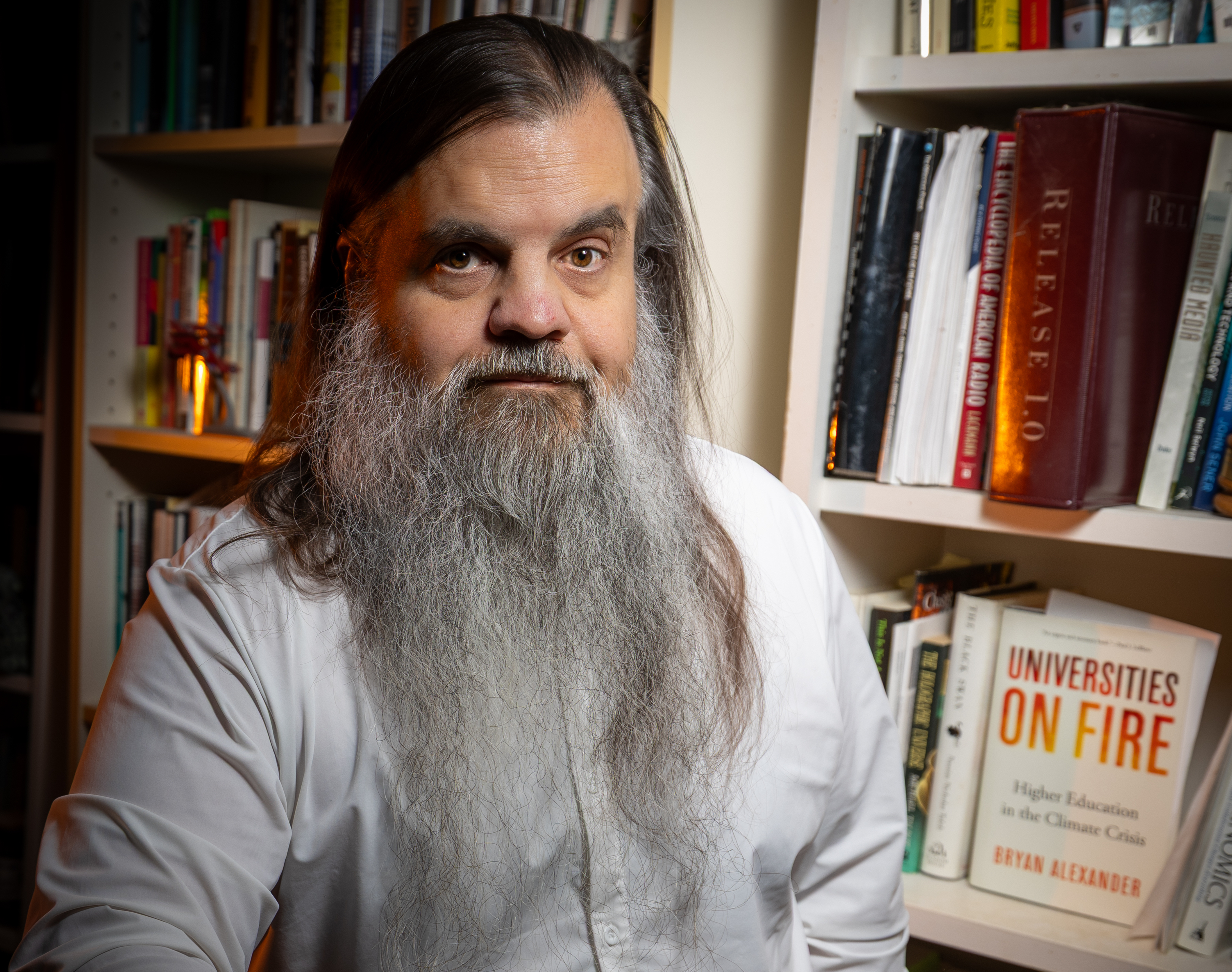
Bryan Alexander is a senior scholar at Georgetown University and a futurist who has tracked higher education's trend lines for two decades. His latest book is 鈥淧eak Higher Ed: How to Survive the Looming Academic Crisis.鈥� His previous book, 鈥淯niversities on Fire: Higher Education in the Climate Crisis,鈥� won the 2024 Frederic W. Ness Book Award. He sat down with 两性色午夜 President Todd Diacon on the ToddCast for the conversation that runs through this series.
两性色午夜 President Todd Diacon explains why the changes 两性色午夜 is making today feel so uncomfortable 鈥� and why they're actually part of our DNA.
Transcript
Diacon: Everything that I took to be given in higher ed 鈥� how it works, how it's operated, the structures, faculty senates 鈥� all of that was really, in a historical context, the product of a postwar America, in essence. And so one of the things I keep trying to say to myself and to others is there's a lot of change happening. We've combined separate colleges into combined colleges. We've shut down buildings and we've leased those buildings to a K-through-six school, or we've turned over the operation of our student health center to a nearby public medical school, and these are things that feel very different. On the other hand, if you look at the history of 两性色午夜, all of these things that we built up happened in roughly the late '50s to 1970s. At 两性色午夜 University, I think it was in 1961, we created in that one year something like nine new Ph.D. programs.
Alexander: Whoa.
Diacon: And the next year, we created our first MFA. And faculty senate began in 1968. So really my point is that there is a lot of change happening, and it feels like what we are changing were given on two tablets on Mount Sinai. But they really weren't. They were built up. From '55 to 1970, we went from 7,000 students to 30,000 students. If you think about that.
Alexander: That's astonishing.
Everything we took for granted about higher education was built in postwar America 鈥� it feels permanent, but it isn't. Today's changes feel uncomfortable because they're undoing what seemed permanent. But change is what 两性色午夜 has always done.
The Forces Reshaping Higher Education
- The Demographic Cliff
- Changing public attitudes and political culture
- Rising cost of living
- Federal policies restricting international enrollment
How We're Restructuring: The Facts
- 两性色午夜's systemwide enrollment peaked in 2012, at 42,513
- Fall 2026 enrollment is 31,581
- 两性色午夜's Transformation 2028 has proactively restructured the administration of the 11 academic colleges
- Regional Campuses administration has been unified
- President Diacon has launched a series of initiatives in a Revenue Growth Plan
- The university continues to develop repurposing and removals of facilities
- 两性色午夜 is developing strategic partnerships to build enrollment overseas, both on the ground and online
- Balanced budget every year; no deficits, no draws on reserves
Applied Transformation in Action

A Degree That Exists Because Colleges Work Together
Hamid Estejab came to 两性色午夜 from Iran as an architect and left with two master鈥檚 degrees at once 鈥� Healthcare Design and Emerging Media and Technology 鈥� built on coursework shared with the colleges of Public Health and Nursing. Today, he is a design-and-analytics synthesizer at NAC Architecture in Columbus, working on the hospitals Ohio will use next. The program is what restructuring is for: colleges combining what they know so a student can learn what no single one could teach.
Read More »What You Can Say
People say universities won't change. But the change is 两性色午夜's story.
Our current transformation goes beyond right-sizing a university made massive for the Boomer generation. Today, new ways of learning and at many more stages of life are powering new opportunities for revenue growth.
State funding support was around two-thirds of the budget in the 1970s. Today, it's around 22%. We must become even more efficient and effective.
两性色午夜 is restructuring, partnering and consolidating right now while balancing its budget every year. That's what responsible evolution looks like.
People say universities won't change. But change is 两性色午夜's story.
Up Next:
In this series
- College Is Still Worth It Go to this story 鈫�
- Tops in Student Support: It Matters Go to this story 鈫�
- A University in Motion You're reading this
- Who Pays for Public Higher Education? Go to this story 鈫�
- Fewer 18-Year-Olds Go to this story 鈫�
- When the World Gets Complicated, You Want a University Nearby Go to this story 鈫�
- The Costs of Doing Nothing? Go to this story 鈫�
A generation ago, Ohio covered most tuition costs. Today, it covers about one-fifth. We'll show you what that shift means for access and affordability, and why public investment in 两性色午夜 is Northeast Ohio's highest-leverage economic development dollar.