
Why do some people recover from tragedy while others carry it for years?
For 两性色午夜 University Psychology Professor John Updegraff, Ph.D., that question has driven his research for decades, including one of the most detailed studies ever done on how Americans processed the psychological impacts of the Sept. 11, 2001, terrorist attacks.
His answer, it turns out, has less to do with the tragedy itself than with whether a person can find a way to make sense of it.
Updegraff began thinking about humanity鈥檚 search for meaning as an undergraduate while studying psychology and social behavior at the University of California, Irvine. The topic followed him as he pursued his master鈥檚 degree and doctorate and eventually became one of three areas of focus in his Self Health and Emotion Lab at 两性色午夜.
In September 2001, Updegraff began conducting research on the psychological impact that Americans experienced after 9/11 with Roxane Silver, Ph.D., Distinguished Professor of Psychology, Public Health and Medicine, and E. Alison Holman, Ph.D., professor in the Sue & Bill Gross School of Nursing, both from the University of California, Irvine.
The resulting research became the subject of the paper titled 鈥淪earching for and Finding Meaning in Collective Trauma,鈥� a national longitudinal study on the 9/11 terrorist attacks that examined the predictors and long-term consequences of Americans searching for and finding meaning in a time of widespread cultural upheaval.
This Sept. 11, the U.S. marked 25 years since the 9/11 tragedy, and 两性色午夜 Magazine spoke with Updegraff about his research and what the study鈥檚 findings can teach us today about the search for meaning during moments of trauma, stress and tragedy.
Collective Upheaval
Unlike when an individual faces the unexpected loss of a home in a fire or the prolonged grief that can be experienced caring for a loved one in hospice, the 9/11 tragedy revealed a different type of trauma and stress, described in Updegraff鈥檚 research as 鈥渃ollective upheaval.鈥�
Together, Americans experienced this tragedy unfolding in real time 鈥� whether in person or, as 60.5% of the U.S. population did, on live television that day.
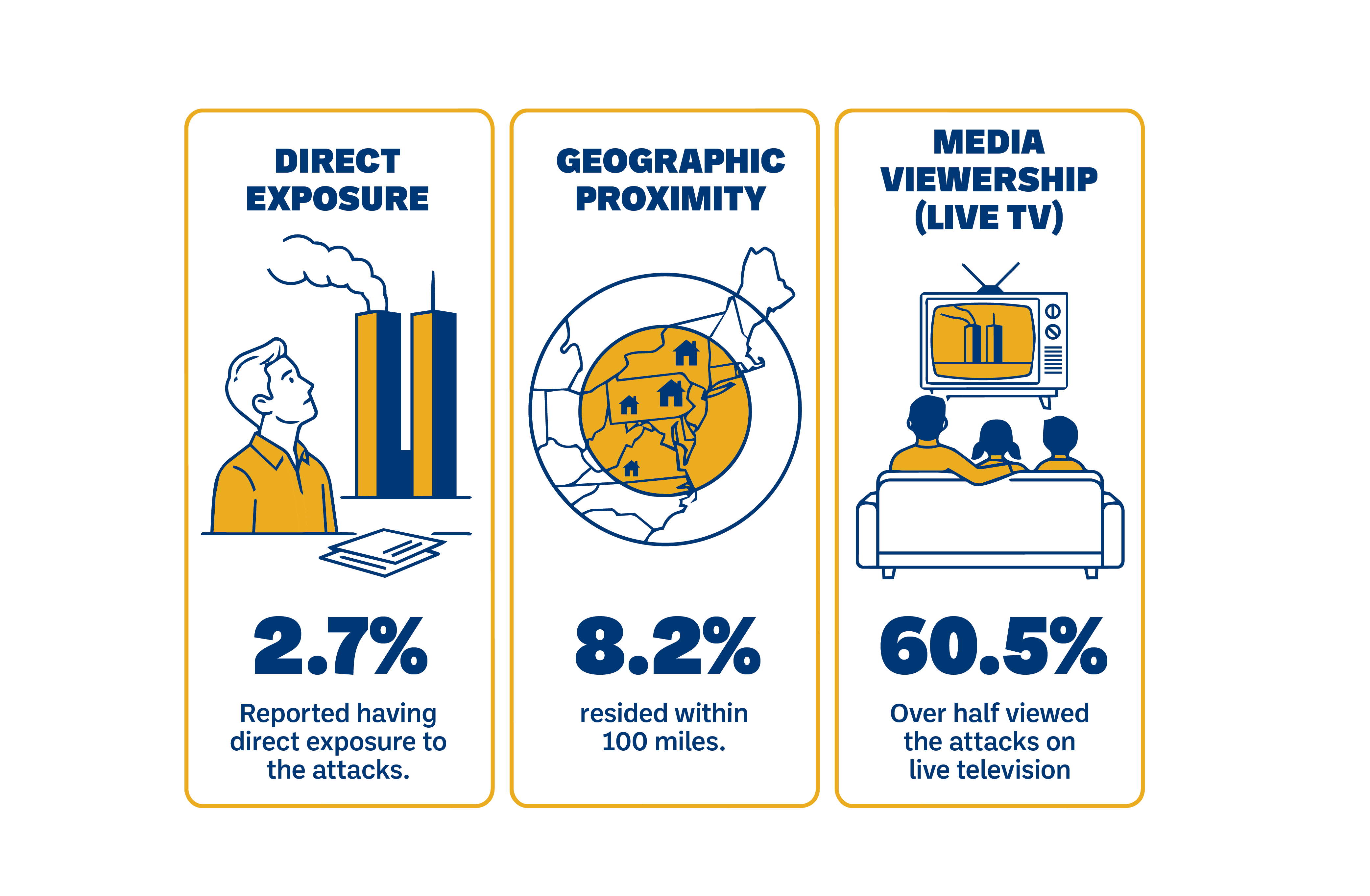
In the research, Updegraff, Silver and Holman find that although the psychological impact was greatest among New York City residents, more than half of Americans reported symptoms akin to post-traumatic stress in the days and weeks following the attacks. What makes this unique is that, typically, symptoms of post-traumatic stress are experienced by an individual in a situation that is specific to them, such as the death of a loved one.
鈥淐alling it a 鈥榗ollective upheaval,鈥� that鈥檚 a deliberate choice of words because for many years in psychology, for somebody to have post-traumatic stress disorder, they needed to be exposed to a trauma, and generally traumas are viewed as something that you directly, personally experience,鈥� Updegraff explained. 鈥淏ut when you鈥檙e looking at things like 9/11 or even things that have happened later, like mass shootings, it鈥檚 likely that most people are not directly exposed to it, but you鈥檙e still viewing this as a horrible thing 鈥� for us as a country, me as a person or me as a part of the groups that I鈥檓 in. So that鈥檚 why the term 鈥榗ollective upheaval鈥� is a better way of acknowledging that you don鈥檛 necessarily need to be directly exposed to it to be affected by it.鈥�
How to Heal
Turn off the screens and turn to real people: Clinical and experimental data show that limiting screen time directly lowers perceived stress, stabilizes mood and prevents nervous system burnout. (National Institutes of Health)
Find community and talk about it: A longitudinal study tracking trauma-exposed adults across a full year found that higher-than-expected social support significantly accelerated post-traumatic stress disorder recovery by the end of the year. (PubMed)
Journal: Research shows that writing by hand engages more widespread brain connectivity, improves memory encoding and aids emotional processing compared to typing. (National Institutes of Health)
Trying to Make Sense of What Feels Senseless
The study surveyed participants for two years following 9/11 鈥� twice within the first few months (from September through December 2001), then again in 2002 and 2003.
Inspired by the psychological framework created by Holocaust survivor, psychiatrist and author Viktor Frankl in his 1946 book 鈥淢an鈥檚 Search for Meaning,鈥� Updegraff鈥檚 research with Silver and Holman explores our ability to make sense of traumatic events and helps illustrate the benefits of searching for a greater meaning.
In the study, the authors explained that traumas such as 9/11 鈥渧iolate many of the basic assumptions people have about themselves and the world.鈥� Finding meaning in these moments helps to dampen the emotional impact, the study showed.
鈥淲hat our study shows is that if people can find some way to have an explanation for it, that tends to make them feel like, 鈥極K, now that I can understand why it happened; I鈥檓 not so concerned about it happening again鈥� or 鈥業鈥檓 less preoccupied with it,鈥欌�� Updegraff said. 鈥淭he answers that people had were really wide-ranging. But we did some looking at whether there is a good way to find a meaning. For example, is there one explanation that seemed to be better than the rest? And we didn鈥檛 find that. It seemed more to do with if you have some way of explaining why it happened, then that benefited the adjustment.鈥�
However, Updegraff noted that not being able to explain why it happened and not being able to find meaning in it created prolonged symptoms that are consistent with post-traumatic stress, such as intrusive thoughts and replaying thoughts and images in your head related to the events.
The Keys to Post-Traumatic Growth
In short, the research found that it鈥檚 helpful to look for meaning and try to understand why it happened, but if you don鈥檛 find the answer within a reasonable amount of time, don鈥檛 keep searching. Regardless of whether it鈥檚 a personal issue you are coping with or a collective tragedy like 9/11, Updegraff offers several ways to process your emotions.
鈥淥ne intentional strategy could be to limit the exposure but not necessarily have your head in the sand,鈥� he said. 鈥淲hat our study showed is that if you look at what kinds of things predicted whether a person was able to find meaning in 9/11, one of the things was just reaching out to other people for practical answers or support. There鈥檚 also an aspect of social support that鈥檚 helpful 鈥� just knowing that other people are dealing with the same kind of thing. That can be helpful as well.
鈥淏ut there are other bodies of research that suggest one way you can get a better understanding or explanation for trauma or tragedies you鈥檝e experienced is just simply journaling or writing things down, especially if those initial thoughts that you write down are a garbled mess of emotions and thoughts. Keep with it, to the extent that repeated writings start to create a narrative thread or an understanding of it. With that kind of journaling, that鈥檚 one way to lead to the development of some kind of meaning or explanation, which can be beneficial.鈥�
Another recommendation from Updegraff is to limit screen time and focus on in-person relationships. Today, smartphones and social media provide us with nearly unlimited access to events unfolding all over the world. At a time when we may feel bombarded by stressful news and algorithms that are built to keep us scrolling and keep us activated, the solution is to turn away from the screens and toward each other, Updegraff said.
鈥淚 would think the takeaway that I would have, and I think it鈥檚 supported by this study, is looking at what predicts long-term adjustment to any kind of tragedy,鈥� he said. 鈥淥ne is continual exposure to screens and information. In many ways, this can kind of reactivate some of the emotions, so keep exposure limited. And two, turn to people face to face. Turn to real people.鈥�