
Research Experiences for Undergraduates
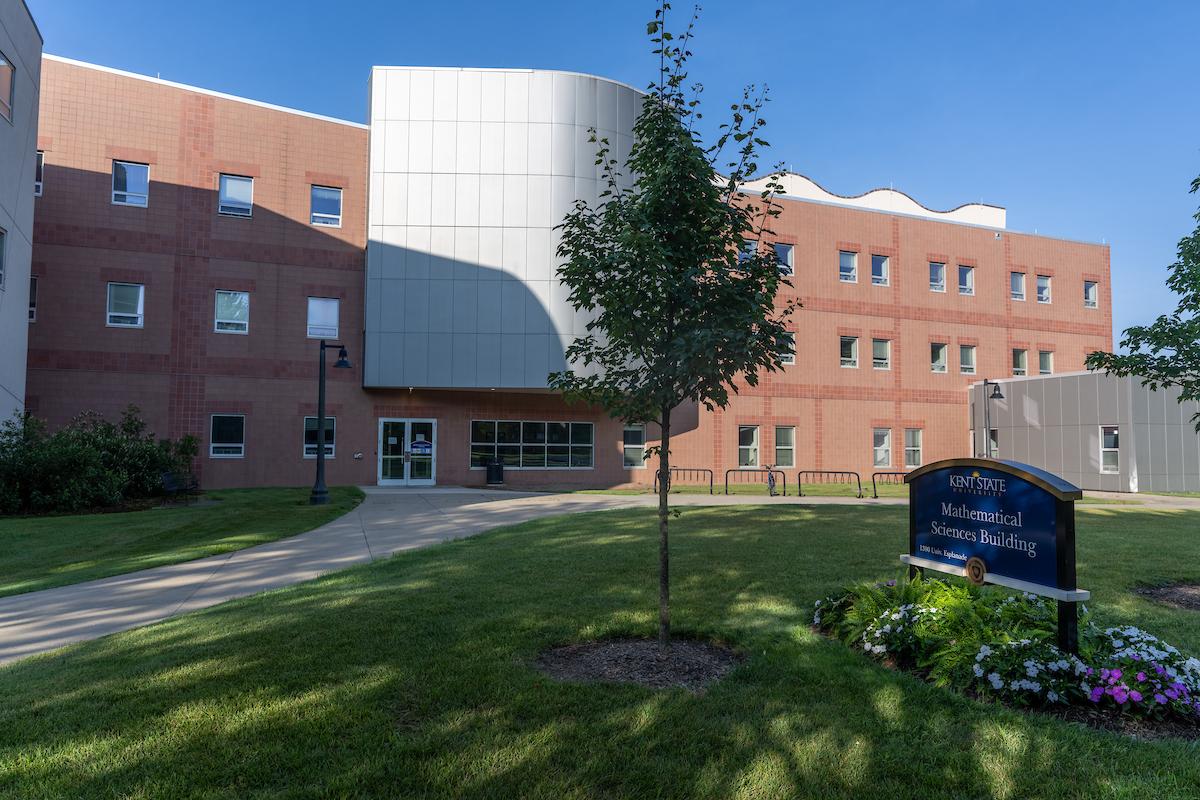
at 两性色午夜 University will run an -funded REU program from June 1 through July 24, 2026. Students will work on projects arising naturally in our faculty's research. The emphasis of the program is on independent work under close supervision of the project advisor.
CONTACT
Jenya Soprunova: esopruno@kent.edu, Mark Lewis: mllewis@kent.edu
Eligibility
To be eligible you must
- Be a US citizen or a permanent resident (Note: We will not be able to accept international students even if they pay for their housing.)
- Be an undergraduate student prior to the program start
- Not graduate by September 2026
Stipend, Room, and Travel
The students will receive $5,600 toward stipend and expenses. We will provide free on-campus housing and will pay up to $400 for travel expenses.
Selection Criteria
For our Summer 2026 program, we will select nine participants based on their completed coursework and grades, the list of courses they plan to take in the spring semester, a letter of recommendation from a faculty member familiar with their work, and a personal statement. We expect applicants to have completed a calculus sequence, a linear algebra course, and at least one advanced upper-division mathematics course (e.g., abstract algebra or analysis).
Many undergraduate students already have this background or a similar one after their freshman year, and we encourage them to apply. We welcome applicants from all backgrounds and do not discriminate on the basis of race, color, religion, sex, gender identity, sexual orientation, national origin, age, or disability. We encourage participation by underrepresented groups but will not give preference based on race, ethnicity, or gender.
For Summer 2026 we will recruit nine students to work on the three projects described below.
Graphs and groups (Mark Lewis)
There are several graphs naturally associated with groups. In this project, we will focus on the commuting graph and the closely related centralizer graph of a group G.
The commuting graph has as its vertex set the noncentral elements of G, with an edge between two vertices g and h whenever gh=hg. The centralizer graph has as vertices the centralizers C_G(g) of noncentral elements g in G. Two vertices C_G(g) and C_G(h) are connected by an edge whenever Z(C_G(h)) is contained C_G(g).
Recall that the diameter of a connected component of a graph is the largest distance between any two vertices in that component, where the distance between two vertices is the length of the shortest path connecting them.
It is known that there is a bijection between the connected components of these two graphs that, in most cases, preserves their diameters. The goal of this project is to investigate whether the diameters of these connected components can be bounded in terms of the index [G:Z(G)].
Prerequisites: At least one semester of undergraduate Abstract Algebra.
References:
- Peter J. Cameron, , Lond. Math. Soc. Newsl. No. 513 (2024), 22鈥�25.
- Peter J. Cameron, , Int. J. Group Theory 11 (2022), no. 2, 53鈥�107.
- Rachel Carleton and Mark L. Lewis, , J. Group Theory 28 (2025), no. 1, 165鈥�178.
- Nicholas F. Bieke, Rachel Carleton, David G. Costanzo, Colin Heath, Mark L. Lewis, Kaiwen Lu, and Jamie D. Peare, , Bull. Aust. Math. Soc. 105 (2022), no. 1, 92鈥�100.
Lattice Point Geometry (Jenya Soprunova)
We will explore questions in lattice point geometry motivated by problems in coding theory and algebraic geometry. No prior background in these areas is expected, and students will be introduced to the necessary concepts as the project progresses. Familiarity with abstract algebra at the undergraduate level may be helpful.
The main object of this project is the lattice size of a lattice polygon. A lattice polygon is a convex polygon P in the plane whose vertices have integer coordinates. The lattice size of P is the smallest number l 鈮� 0 such that, after applying an affine unimodular transformation A (that is, a change of coordinates that preserves the integer lattice), the polygon A(P) fits inside the dilated simplex l鈭�. Here 鈭� is the unit simplex, namely the triangle with vertices (0,0), (1,0), and (0,1). See Example 1.2 in the first paper below for an illustration of this definition.
A possible goal for this summer is to describe lattice polygons P of a given lattice size l 鈮� 0 with the property that any lattice polygon Q properly contained in P has strictly smaller lattice size.
The papers listed below are results of previous REU projects on this topic. They contain a broad range of results on lattice size. While much of the material goes beyond the scope of this project, you can take a look at them for the precise definitions and for some of the first results.
References:
- Abdulrahman Alajmi, Sayok Chakravarty, Zachary Kaplan, and Jenya Soprunova, , Involve, a Journal of Mathematics 17-1 (2024), 153--162.
- Anthony Harrison, Jenya Soprunova, Patrick Tierney, , SIAM J. Discrete Math. 36, No 1 (2022), 92-102.
Differential Equations and Applications (Fedor Nazarov and Peter Gordon)
The project will be devoted to questions concerning the qualitative behavior of the solutions of differential equations that have completely elementary formulations yet are only partially analyzed. These equations originate from various applications ranging from physics to convex geometry and most likely require a fresh look rather than more advanced technical skills. Both the analytical and the numerical approaches may be explored.
A typical convex geometry example is as follows. Let K be a bounded convex body. The body of flotation of K is a convex body obtained by cutting off K all caps of fixed volume by hyperplanes. Assume that the body of flotation F of K is a ball. Does it mean that K is a ball itself? In case when K is a body of revolution and, in addition, the centers of mass of caps lie on a sphere with the same center as F, the problem can be reduced to a system of differential equations in even dimensions. The problem has been fully analyzed in dimensions 2 and 4, but still remains open even in dimension 6. See for more details.
An example from physically motivated problems is an analysis of a model of thermal explosion in reactive jets. The model was derived in and studied in . A possible project may involve the derivation of asymptotically sharp uniform bounds on the solutions of a certain second order differential equation.
References:
- M.A. Alfonseca, D. Ryabogin, A. Stancu, V. Yaskin, , Pure and Appl. Func. Analysis (to appear).
- P.V. Gordon, U.G. Hegde, M.C. Hicks, , SIAM J. Appl. Math., 78(2) (2018), 705-718.
- P.V. Gordon, V. Moroz and F. Nazarov, , Journal of Differential Equations, 269(7), (2020), 5959-5996.
Prerequisites: Undergraduate Analysis, Elementary ODE鈥檚.
Application Deadline: Friday February 13, 2026
The application is available at .
To complete your application, you will be asked to provide the following:
- CV or Resume
- A personal statement (3-5 paragraphs) describing your interest in mathematics, relevant background, prior research experience (if any), and career goals. You will also be asked to describe your experience in the most advanced math course you have taken;
- A response indicating which of the three projects you are most interested in and why;
- Unofficial college transcript including Fall 2025 semester;
- Contact information for two references. They will receive an email with instructions for submitting a reference form through the system. Please speak with your letter writers before entering their email addresses. We recommend requesting letters from mathematics instructors, especially those who have taught your most advanced courses, or from mentors who supervised a research project in which you participated.
- Nicolas F. Beike, Rachel Carleton, David G. Costanzo, Colin Heath, Mark L. Lewis, Kaiwen Lu, and Jamie D. Pearce, , S茫o Paulo J. Math. Sci. 18 (2024), no. 2, 1651鈥�1669.
- David G. Costanzo, Mark L. Lewis, Stefano Schmidt, Eyob Tsegaye and Gabe Udell, , Czechoslovak Math. J. 74(149) (2024), no. 2, 637鈥�645.
- Abdulrahman Alajmi, Sayok Chakravarty, Zachary Kaplan, and Jenya Soprunova, , Involve, a Journal of Mathematics 17-1 (2024), 153--162.
- Nicolas F. Beike, Rachel Carleton, David G. Costanzo, Colin Heath, Mark L. Lewis, Kaiwen Lu, and Jamie D. Pearce, , Bull. Aust. Math. Soc. 109 (2024), no. 2, 342-349.
- Nicolas F. Beike, Rachel Carleton, David G. Costanzo, Colin Heath, Mark L. Lewis, Kaiwen Lu, and Jamie D. Pearce, , Bull. Aust. Math. Soc. 108 (2023), no. 3, 443-448.
- Nikita Borisov, Hayden Julius and Martha Sikora, , J. Algebra Appl., 21, No. 06, (2022), 2250123.
- Nicolas F. Beike, Rachel Carleton, David G. Costanzo, Colin Heath, Mark L. Lewis, Kaiwen Lu, and Jamie D. Pearce, , Bull. Aust. Math. Soc. 105 (2022), no. 1, 92鈥�100.
- David G. Costanzo, Mark L. Lewis, Stefano Schmidt, Eyob Tsegaye and Gabe Udell, , Bull. Aust. Math. Soc., Bull. Aust. Math. Soc. 104 (2021), no. 2, 295鈥�301.
- David G. Costanzo, Mark L. Lewis, Stefano Schmidt, Eyob Tsegaye and Gabe Udell, , Involve 14 (2021), 167--179.
- Kyle Meyer, Ivan Soprunov, Jenya Soprunova,, SIAM Journal on Applied Algebra and Geometry 6, No 3 (2022), 432-467.
- Anthony Harrison, Jenya Soprunova, Patrick Tierney, , SIAM J. Discrete Math. 36, No 1 (2022), 92-102.
- Louisa Catalano and Megan Chang-Lee, , Linear and Multilinear Algebra, 69(16) (2021), 3092鈥�3098.
- Aria Beaupre, Emily Hoopes-Boyd and Grace O'Brien, , Linear Algebra Appl. 610 (2021), 827--836.
- Steven Jin and Jooyoung Shin, , Comm. Algebra 49 (2021), 256--262.
- Victor Ginsburg, Hayden Julius and Ricardo Velasquez, , Linear Algebra Appl. 593 (2020), 212--227.
- Louisa Catalano and Megan Chang-Lee, , Bull. Aust. Math. Soc., 101 (2020), 438--441.
- Fei Yu Chen, Hannah Hagan and Allison Wang, , Int. J. Algebra Comp. 30 (2020), 117--123.
- Fei Yu Chen, Hannah Hagan and Allison Wang, , Comm. Algebra, 47 (2019), 1102--1104.
- Jeffrey Okamoto, Natasha Stewart, Jun Li, , R Package Version 0.1.0, 2018.
- Louisa Catalano, Samuel Hsu and Regan Kapalko, , Linear Algebra Appl. 563 (2019), 193--206.
- William Clark, Andrew Ahn, Shahaf Nitzan and Joseph Sullivan, , J. Fourier Anal. Appl., 24 (2018), 699--718.
- Alexander Ma and Jamie Oliva, , Linear Algebra Appl. 492 (2016), 13--25.
- Cailan Li and Man Cheung Tsui, , Linear Algebra Appl. 493 (2016), 399--410.
- Katherine Cordwell and George Wang, , Linear Algebra Appl. 496 (2016), 262--287.
- Sarah Manski, Jacob Mayle, Nathaniel Zbacnik, , INTEGERS, 15 (2015), A28, 16 pages.
- Benjamin Anzis, Zachary Emrich, Kaavya Valiveti, , Linear Algebra Appl. 469 (2015), 51--75.
- Michael Kaufman and Lillian Pasley, , Involve 7 (2014), 769--772.
- David Buzinski and Robin Winstanley, , Linear Algebra Appl., 439 (2013), 2712--2719.
- James Moody, Corey Stone, David Zach, and Artem Zvavitch, , Asymptotic Geometric Analysis, Fields Institute Communications, 68 (2013), 221--229.
- Olivia Beckwith, Matthew Grimm, Jenya Soprunova, and Bradley Weaver, , Discrete and Computational Geometry, 48 (2012), 1137--1158.
- Thomas Dinitz, Matthew Hartman, and Jenya Soprunova,, Linear Algebra Appl., 436 (2012) 1212--1227.
- Toan Duc Dinh and Michael Donzella, , Linear Algebra Appl., 432 (2010), 493--498.
REU 2009
Students: Toan Duc Dinh, Michael Donzella, Thomas Dinitz, Matthew Hartman, Lizbee Collins-Wildman, Matthew Hoffman, Benjamin Mackey, Catherine Pizzano
Advisors: Mikhail Chebotar, Jenya Soprunova, Andrew Tonge, Laura Smithies
REU 2010
Students: James Moody, Corey Stone, David Zach, Bren Cavallo, Lynne DeYoung, Matthew Alexander, Sarah Mullin, Hannah Yee, Olivia Beckwith, Matthew Grimm, Bradley Weaver
Advisors: Artem Zvavitch, Laura Smithies, Dmitry Ryabogin, Jenya Soprunova
Graduate Students: John Hoffman, Michelle Cordier
REU 2011
Students: Ian Barnett, Benjamin Fulan, Candice Quinn, William Kanegis, Zhiyuan Lu, Peggy Sah, Bradley Weaver, Amy Beard, Emily Heath, Andrew Zeller
Advisors: Morley Davidson, Don White, Steve Gagola, Jenya Soprunova
Graduate Students: John Hoffman, Michelle Cordier, Galyna Livshyts
REU 2013
Students: David Buzinski, Michael Kaufman, Lillian Pasley, Robin Winstanley, Rachel Carleton, Dorothy Klein, Hope Snyder, Ryann Cartor, Riley Burkart, Kyle Meyer, Cody Stockdale
Advisors: Misha Chebotar, Andrew Tonge, Jenya Soprunova
Graduate students: Michelle Cordier, John Hoffman, Matt Alexander.
REU 2014
Students: Zachary Emrich, Benjamin Anzis, Kaavya Valiveti, Sarah Manski, Jacob Mayle, Nathaniel Zbacnik, William Clark, Andrew Ahn, Joseph Sullivan
Advisors: Misha Chebotar, John Hoffman, Gang Yu, Shahaf Nitzan
Graduate students: Michelle Cordier, Mike Doyle, Matt Alexander
REU 2015
Students: Alex Ma, Jamie Oliva, Cailan Li, Man-Cheung Tsui, Katherine Cordwell , George Wang, Emma Cinatl, Margaret Allardice, Patrick Tierney
Advisors: Misha Chebotar, Jenya Soprunova
Graduate students: Anthony Harrison, Matt Alexander, Isaac Defrain
REU 2018
Students: Natasha Stewart, Jeffrey Okamoto, Zachary Kaplan, Sayok Chakravarty, Hannah Hagan, Regan Kapalko, Fei Yu (Dennis) Chen, Allison Wang, Samuel Hsu
Advisors: Misha Chebotar, Jun Li, Jenya Soprunova
Graduate students: Abdul Alajmi, Louisa Catalano, Anna Levina, Tomas Rodriguez
REU 2019
Students: Victor Ginsburg, Megan Chang-Lee, Ricardo Velasquez, Eyob Tsegaye, Gabriel Udell, Stefano Schmidt, Isabelle Hauge, Molly Noel, Olivia Beck
Advisors: Misha Chebotar, Mark Lewis, Jun Li
Graduate students: Louisa Catalano, Emily Hoopes, David Costanzo, Hayden Julius